Best WiFi and Internet Providers in Thailand 2026
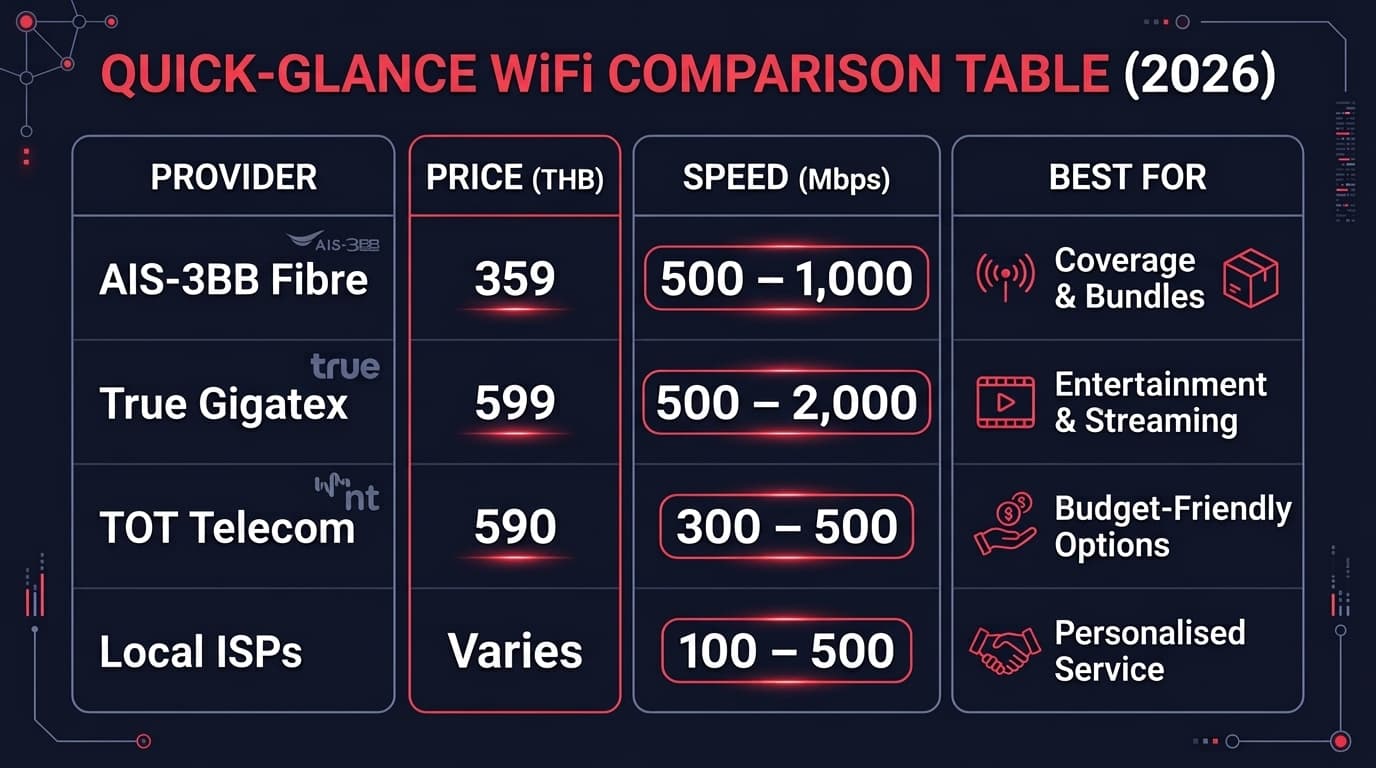
Getting connected when you first arrive in Thailand is one of those tasks that should be straightforward and somehow never quite is. The market has changed significantly heading into 2026, and a lot of the advice circulating online is based on a structure that no longer exists. Here is what you actually need to know.
What Changed in the Market
Two things happened that reshaped the landscape.
True and DTAC merged. The two companies completed their merger in 2023 and finished integrating their networks in late 2025. They operate as one company — True Corp — though DTAC survives as a prepaid SIM brand. If you have older advice recommending DTAC as a separate network, it is now effectively True Move H with a different logo on the packaging.
AIS acquired 3BB. AIS bought 3BB through its subsidiary Advanced Wireless Network. Home fiber is now sold under the AIS-3BB Fibre3 brand in most areas. For the purposes of choosing a provider, treat AIS and 3BB as the same option.
The practical result: Thailand's internet market is a duopoly. AIS and True Corp control over 95% of the market. NT (National Telecom, formerly TOT) exists as a third option where the main two do not reach.
Home Fiber: What to Get and Where
AIS-3BB Fibre3 is the reliable choice across most of Thailand, and Phuket specifically. AIS has the broadest fiber coverage, the most consistent speeds, and the better rural and island reach. In Phuket, this means Bang Tao, Rawai, Kamala, Chalong, Nai Harn, and most of the north-west corridor are well covered.
Pricing for home fiber:
- —500 Mbps symmetrical: THB 599/month
- —1 Gbps symmetrical: THB 799/month
- —Rates are cheaper on a 24-month contract vs month-to-month
True Online is competitive, particularly in Phuket Town and Patong, and worth checking if you live in those areas. True's fiber network reaches most of the same residential zones with comparable pricing. If True is running a promotion in your area, the numbers can be similar enough that the choice comes down to whichever sales rep turns up first.
NT (National Telecom) is the fallback. It tends to be cheaper, has a government-backed obligation to serve areas the commercial providers skip, and installation takes longer — typically one to three weeks versus three to seven working days for AIS or True. If you are in a rural area or a development that the main two have not reached, NT is worth calling.
Starlink is available in Phuket in 2026 and is worth knowing about for two scenarios: properties in genuinely remote locations where fiber does not reach, and buyers who want a connection that is fully independent of Thai provider infrastructure. It costs significantly more than fiber and requires a satellite dish installation, but it works where nothing else does.
Getting Set Up as a Foreigner
Both AIS and True accept foreign applicants. What you need:
- —Passport
- —Rental agreement or proof of address
- —A Thai mobile phone number
The Thai phone number requirement catches people out. The provider ties your account to a local number, which creates a catch-22 for new arrivals who do not have one yet. The practical fix: get a prepaid SIM on day one (any 7-Eleven, airport counter, or AIS/True shop — passport required, takes five minutes), use that number to apply for home fiber, then upgrade to postpaid mobile later if you want.
Installation fees of THB 1,000–3,000 are standard but regularly waived during promotional periods. Ask. The 12-month contract is the default; month-to-month options exist but cost more. If you are on a long lease, take the 12-month contract.
Mobile SIM: Postpaid or Prepaid
For a long-term resident, postpaid is almost always the right choice. The plans are better, the data allowances are larger, and you are not topping up every two weeks.
AIS postpaid:
- —Entry: THB 599/month — 30GB of 5G data
- —Unlimited: THB 1,099/month
- —Best 5G coverage and speeds nationwide. The right call if you travel outside Phuket regularly.
True Move H postpaid:
- —Competitive on price, frequently bundles streaming access (TrueVisions, HBO Go)
- —Good network in Bangkok and tourist cities. Post-merger combined spectrum has improved rural performance, but AIS still leads outside urban areas.
Both AIS and True Move H now support eSIM, which is useful if you travel frequently between Thailand and your home country and want to keep a home-country number active.
What Most Guides Do Not Tell You
Unlimited does not mean unlimited. Both providers apply a fair use policy to unlimited data plans. The typical ceiling is around 2.5 GB per day at full speed, after which your connection throttles until midnight. For most users this is fine; for anyone running a video call-heavy work setup from mobile data, it is worth knowing before you sign up.
Building coverage varies. Older condo developments and houses with thick concrete walls can have poor indoor coverage even in areas with strong outdoor signal. If signal matters to you, test a prepaid SIM in your specific apartment before committing to a postpaid contract.
The Practical Setup Sequence
- —Buy a prepaid SIM at the airport or any 7-Eleven (passport required). AIS or True — either works.
- —Use that number to apply for home fiber (AIS-3BB or True — check what covers your specific address).
- —Wait three to seven working days for installation.
- —Once settled, upgrade to postpaid mobile if you want — your Thai number transfers.
- —If you are in a remote area or want backup connectivity, research Starlink separately.
The whole setup takes about a week from landing to having reliable home fiber, assuming you are in a covered area.