Foreign Ownership in Thailand 2026: What You Actually Own and the Structures That Work
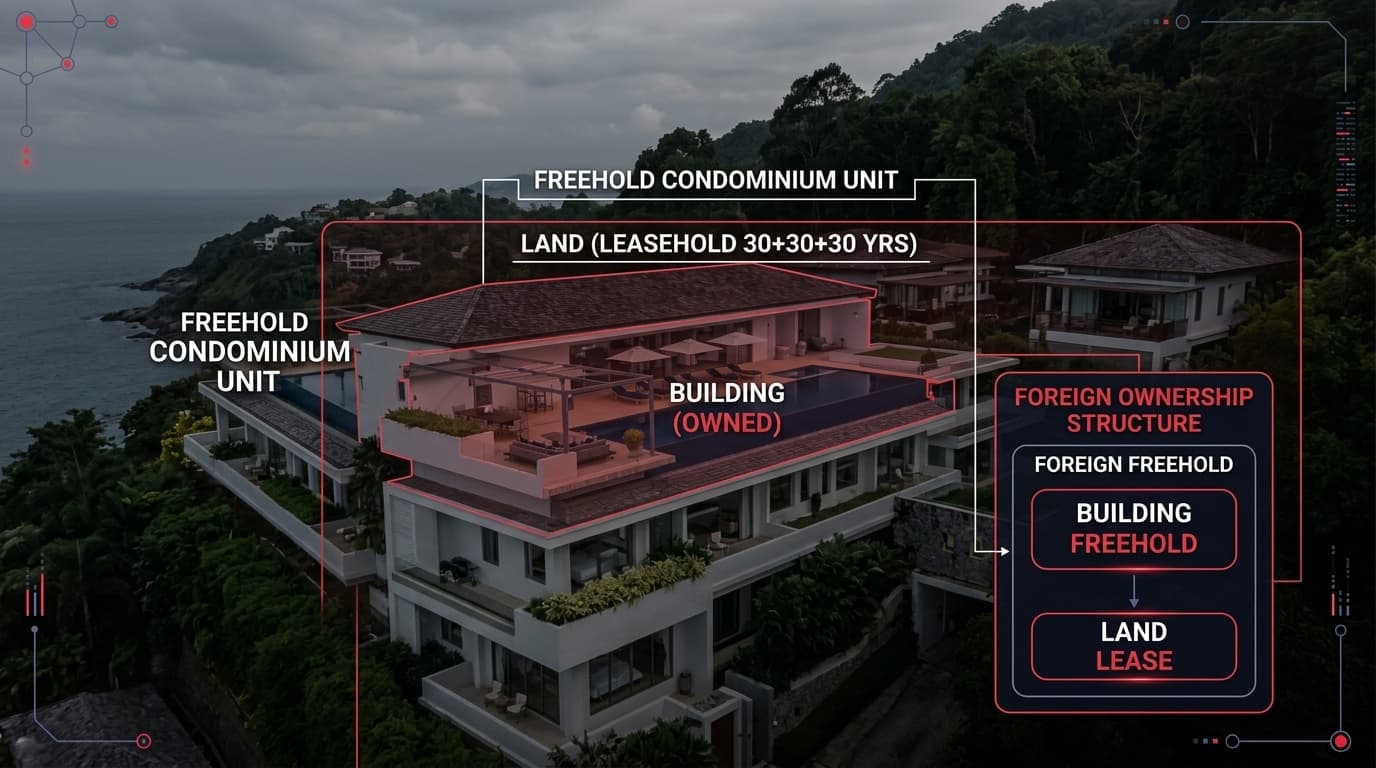
The most important thing to understand about buying property in Thailand as a foreigner is this: you cannot own land. That is the baseline position under Thai law, and it has not changed. What has changed in 2026 is the enforcement context around the structures people have historically used to work around that restriction — some legitimately, some not.
This guide covers the four structures that are actually in use, what you own under each, and what the honest limitations are. It is written for buyers doing genuine due diligence, not for those looking for reassurance.
Structure 1: Freehold Condominium Ownership
This is the cleanest structure available to foreign buyers and the starting point for anyone who does not have a specific reason to choose otherwise.
Under the Condominium Act B.E. 2522, foreign nationals can own condominium units in their own name in freehold — meaning registered ownership at the Land Office, title held directly, no intermediary structure required. The constraint is a building-level quota: foreigners can own up to 49% of a building's total registered floor area. The remaining 51% must be Thai-owned.
What you actually own: A Chanote (full title deed) in your name. The unit itself, plus a proportional share of the common areas. Inheritable by your heirs under Thai law with appropriate estate planning.
The foreign quota in practice: In high-demand buildings — particularly in Cherng Talay, Bang Tao, and Surin on Phuket's north-west coast — the foreign quota exhausts quickly. Some buildings are fully allocated on launch. Verify current quota status before making any commitment, and build in contractual protection if you are buying off-plan.
The 75% proposal: Proposals to raise the foreign quota to 75% in designated zones have circulated through 2025 and 2026. As of the date of this guide, they have not been enacted. The 49% cap is the enforceable rule for anyone buying today. Do not make a purchase decision based on a change that has not happened.
The funding requirement: Foreign freehold condo ownership requires funds to be transferred from overseas in a foreign currency. The bank issues a Foreign Exchange Transaction (FET) certificate confirming the inward transfer. This is not optional — it is the legal mechanism that validates your ownership, and it is checked at transfer. Keep every FET certificate.
Structure 2: Registered Leasehold
For buyers who want landed property — a villa, a house, or serviced land — the registered leasehold is the standard legal route. You lease the land from a Thai landowner for a fixed term, registered at the Land Office.
What you actually own: The right to occupy and use the land for the term of the lease. If you have also registered a superficies (see below), you own the building itself. You do not own the land.
The 30-year cap: Thai law caps a registered lease at 30 years. This is the maximum. There is no legal mechanism to extend the statutory maximum.
On renewal clauses: Many developers and agents sell villas on "30+30+30" or "30+30" terms, presenting the renewal option as close to freehold in practice. This is incorrect, and the point is now settled law.
In March 2025, the Thai Supreme Court invalidated pre-agreed lease renewal clauses. A clause in a lease contract promising renewal is not enforceable. What this means in practice: your 30-year lease runs for 30 years. Whether you can renew depends entirely on the willingness of the landowner at the time of expiry — who may be a different person from the one you dealt with originally, may have different financial circumstances, and is under no legal obligation to renew on the original terms.
This is the most under-reported material legal change of the last 12 months. If you are evaluating a villa leasehold sold on the basis of renewal options, factor this into your risk assessment.
Leasehold duration and negotiation: 30 years from registration is the maximum and is what most buyers seek. Push for the full 30 years registered from the outset.
Structure 3: Stacking Leasehold with Superficies or Usufruct
The 2026 best practice for landed property is not a bare leasehold but a stacked structure that gives the foreign buyer additional registered rights over the building and use of the land.
Superficies (governed by Civil and Commercial Code sections 1410–1416) grants the right to own buildings or structures on another person's land, registered at the Land Office for up to 30 years. The key distinction from a leasehold: a superficies right can be inherited by your heirs. A lease typically cannot.
The standard structure for a foreign villa buyer in 2026:
- —Registered leasehold on the land (30 years)
- —Registered superficies on the building (up to 30 years)
This gives you registered lease rights over the land and freehold ownership of the building structure itself — transferable, inheritable, and legally distinct from the land tenure. If the landowner sells the land during your lease term, your registered rights follow the land under Thai law.
Usufruct grants the right to use and receive the benefits of property for either a fixed term (up to 30 years) or for life. It is registered at the Land Office and commonly used as an additional layer in leasehold arrangements, particularly where the buyer intends to rent out the property. A usufruct for life runs as long as the usufructuary lives — it cannot be transferred or inherited, but it also cannot be extinguished by a change of landowner.
Structure 4: Thai Company Ownership
A Thai company may own land. This is a legal fact. The question is whether the company you are proposing to use is a genuine business or a nominee structure, and in 2026, the distinction is being tested with more rigour than at any point in the past decade.
Nominee structure: A Thai company where Thai nationals hold shares on behalf of a foreign beneficial owner, with no genuine business activity, purely as a vehicle to hold land. This violates the Land Code. It has always violated the Land Code. What has changed is the enforcement.
The Department of Business Development (DBD) now operates an AI-driven screening system (IBAS) that cross-references corporate registry data against multiple government databases in real time to flag nominee indicators. Five government agencies are coordinating enforcement. Over 21,000 companies are currently under investigation nationally. 852 have been prosecuted. More than 600 companies in Phuket alone are under active review.
A proposed amendment to the Land Code would replace the current remedy — a forced sale where the owner receives proceeds — with outright state forfeiture. This amendment has not yet been enacted, but the direction of enforcement policy has moved consistently toward greater penalties every quarter since Q4 2025.
Hawook position: for buyers currently holding property through a nominee company, a legal review is the immediate priority. For buyers evaluating a new purchase, this route is not one Hawook would recommend.
Which Structure for Which Buyer
Condo buyer (lifestyle or investment): Freehold in your own name, within the foreign quota. Verify quota status and fund via overseas transfer with FET certificate.
Villa buyer, long-term resident: 30-year registered leasehold on the land, registered superficies on the building. Push for the full 30 years registered from the outset — do not rely on renewal clauses.
Buyer presented with a Thai company structure: Ask whether this is a genuine business or a holding structure. If the answer involves Thai shareholders who are not genuinely involved, do not proceed without independent legal advice and a clear understanding of the current enforcement environment.
What to Check Regardless of Structure
- —Title deed type: Chanote (full title, registerable) is the only deed worth holding.
- —Foreign quota status (condos): verify with the Land Office or the building's juristic person, not with the developer or agent.
- —FET certificate: confirm your funds were transferred from overseas in foreign currency and obtain the FET certificate from your bank before transfer.
- —Independent legal counsel: the lawyer who handles your transaction should be instructed by you, not the seller or developer.
- —For leasehold: confirm the lease is registered at the Land Office and appears on the Chanote.
This guide is for informational purposes and does not constitute legal advice. The law in this area is specific, and the enforcement environment in 2026 is evolving. Get independent advice from a qualified Thai property lawyer before making any purchase decision.